OptionDiv4 is one of those terms that sounds complex at first but reveals an elegant simplicity once you understand what it actually does. Whether you are a developer building dynamic web applications, a business owner managing digital workflows, or a designer trying to create cleaner user interfaces, OptionDiv4 offers a structured framework that makes your work faster, cleaner, and more scalable. This guide unlocks everything about OptionDiv4 so you can apply it immediately and confidently in your own projects.
The digital world moves fast. Systems that cannot adapt to changing demands break under pressure. OptionDiv4 addresses this directly by providing a modular, layered approach to organizing decisions, options, and processes in any digital environment. It is not just a coding convention. It is a blueprint for how modern digital systems should be designed to handle complexity without creating chaos. Understanding it fully changes how you approach every project you build or manage going forward.
This guide covers what OptionDiv4 is, how it works, its core features, real-world applications, best practices, common mistakes to avoid, and a clear comparison with alternative approaches. By the end you will have everything you need to implement OptionDiv4 effectively regardless of your experience level or technical background.
What Is OptionDiv4
OptionDiv4 refers to a structured framework used in digital systems to organize decisions, manage multiple options, and streamline workflows in a layered, efficient manner. The name breaks down simply: Option refers to selectable choices within a system, Div is shorthand for division representing distinct sections or containers of content, and 4 denotes the fourth level in a structured hierarchy. Together these components describe a system that handles advanced, deeply nested options in an organized and user-friendly way.
In web development, OptionDiv4 appears as a fourth-level container that holds selectable elements within a structured HTML layout. In business and operations contexts, it functions as a decision hierarchy framework that guides users through complex choices step by step without overwhelming them. In financial and investment systems, it serves as a structured model that organizes options and automates decision pathways based on predefined criteria.
What makes OptionDiv4 genuinely powerful is its flexibility. The same core principle of layered, organized option management applies equally whether you are building a product comparison table on an e-commerce website, managing a multi-tier pricing dashboard, organizing complex dropdown menus in a web application, or structuring decision trees in a business operations system. The framework adapts to your specific context without requiring you to reinvent the approach from scratch every time.
How OptionDiv4 Works
Understanding how OptionDiv4 works requires understanding the layered structure it operates within. Digital systems that use OptionDiv4 organize their options hierarchically. The first three levels handle progressively more specific choices, and OptionDiv4 represents the fourth and most advanced tier where highly specific, customized options live. Users reach this level only after progressing through earlier layers, which means by the time they arrive at OptionDiv4, they are engaged, informed, and ready for advanced decisions.
| Level | Name | What It Contains | User Type |
| Level 1 | OptionDiv1 | Broad categories and primary navigation choices | All users at entry point |
| Level 2 | OptionDiv2 | Subcategories and secondary filter options | Users who narrowed their search |
| Level 3 | OptionDiv3 | Specific product, feature, or configuration selections | Engaged users with clear intent |
| Level 4 | OptionDiv4 | Advanced customization and highly specific decision options | Power users and decision makers |
When a user or system reaches OptionDiv4, the framework triggers specific responses based on predetermined logic. In web development this might mean displaying a specialized configuration panel. In a business workflow it might mean routing a decision to a senior team member for final approval. In a financial system it might mean executing a specific investment strategy based on all the parameters set in the previous three levels. The intelligence of the framework lies in this progressive disclosure approach where complexity is introduced gradually rather than all at once.
Core Features of OptionDiv4
Learn more:Etsjavaapp Download Guide: Everything You Need to Know in 2026
OptionDiv4 comes with a set of defining features that make it genuinely useful across a wide range of applications. These are not theoretical benefits. They are practical capabilities that users and developers experience directly every time the framework is properly implemented:
| Feature | Description | Practical Benefit |
| Layered Decision Structure | Organizes choices into four progressive levels | Users are never overwhelmed by too many options at once |
| Modular Architecture | Each component works independently but connects cleanly | Add or remove features without breaking the entire system |
| Real-Time Feedback | JavaScript interaction provides instant response to user actions | Users know immediately when their choices are registered |
| Workflow Automation | Predefined logic automates responses to specific option selections | Reduces manual work and eliminates repetitive decision steps |
| Cross-Platform Compatibility | Works consistently across desktop, mobile, and tablet devices | Users get the same clean experience regardless of their device |
| Customizable Settings | Every parameter can be adjusted to match specific workflow needs | Teams can tailor the framework without rebuilding from scratch |
| Performance Analytics | Tracks how users interact with options across all four levels | Data-driven insights improve decision structures over time |
| Security Integration | Built-in access controls protect sensitive option configurations | Only authorized users can access advanced OptionDiv4 settings |
Real-World Applications of OptionDiv4
OptionDiv4 is not limited to a single industry or use case. Its structured approach to option management makes it valuable across a surprisingly wide range of real-world contexts. Here are the most impactful applications currently in use:
E-Commerce and Product Configuration
Online stores with complex product catalogs use OptionDiv4 to manage product filtering and configuration in a clean, user-friendly way. A customer shopping for a laptop might progress through OptionDiv1 for brand selection, OptionDiv2 for screen size, OptionDiv3 for processor type, and OptionDiv4 for specific storage and RAM configurations. Each level narrows the options logically so the customer reaches their exact choice without scrolling through hundreds of irrelevant products. One implementation of this approach reduced customer complaints about irrelevant options by 60 percent because the interface adapted to what each person actually needed.
Web Application Dashboards
Complex web applications with multiple user types use OptionDiv4 to serve different experiences from a single codebase. Basic users see simplified dashboards with essential options at the first two levels. Power users and administrators progress to OptionDiv4 where advanced configuration, reporting, and system management tools become available. This progressive disclosure approach keeps the interface clean for beginners while ensuring that advanced users have full access to everything they need without navigating through separate interfaces.
Financial and Investment Platforms
Investment platforms use OptionDiv4 to structure decision pathways for portfolio management. An investor might select their investment goals at level one, their risk tolerance at level two, their preferred asset classes at level three, and their specific allocation percentages and rebalancing triggers at level four. The framework automates actions based on these selections, reducing the manual work involved in maintaining a consistent investment strategy and minimizing the emotional decision-making that leads to poor financial outcomes.
Business Operations and Workflow Management
Operations teams use OptionDiv4 to structure approval workflows, task routing systems, and escalation processes. Standard requests are handled at the first two levels automatically. Complex or high-value decisions progress to OptionDiv4 where senior decision-makers review and approve before execution. This structure ensures that routine work moves quickly while important decisions receive appropriate attention without creating bottlenecks across the entire workflow.
How to Implement OptionDiv4 in Your Project
Implementing OptionDiv4 correctly requires following a clear process rather than jumping straight into code. The planning stage is what separates successful implementations from those that create more problems than they solve. Follow these steps in order for the cleanest, most effective result:
Map Your Decision Hierarchy
Before writing a single line of code, map out every decision point in your system. Identify which choices are broad entry-level decisions and which are highly specific advanced configurations. Assign each decision to one of the four levels based on its specificity and the type of user who typically makes it. This mapping exercise usually reveals redundancies and unnecessary complexity that you can eliminate before building anything.
Define Your Option Containers
Create clearly labeled containers for each level. In web development this means setting up your HTML and CSS structure so each OptionDiv level has distinct styling and behavior. In a workflow system this means defining the rules that govern when a decision escalates from one level to the next. Clear container definitions make collaboration easier because every team member knows exactly which section of the system they are working with at any given time.
Build the Logic Layer
The logic layer is what makes OptionDiv4 intelligent rather than just organized. Write the JavaScript, backend logic, or workflow rules that determine what happens when a user reaches each level and makes a specific selection. At OptionDiv4 this logic should be precise and well-tested because it handles the most consequential decisions in your system. Test every possible path through the decision hierarchy before deployment.
Optimize for Performance
A well-structured OptionDiv4 system should be fast. Lazy-load content at deeper levels so users do not wait for advanced options to load when they first enter the system. Cache frequently accessed option configurations to reduce server load. Minimize the JavaScript running at each level to keep interactions smooth and responsive on all devices including older mobile phones with limited processing power.
Test Across All User Types
Test your OptionDiv4 implementation with representatives from every user type you designed it for. Beginners should find the first levels intuitive and not feel overwhelmed. Advanced users should reach OptionDiv4 without unnecessary friction. Test on multiple devices, browsers, and screen sizes to ensure the experience is consistent everywhere your users might access the system.
OptionDiv4 vs Alternative Approaches
Understanding how OptionDiv4 compares to alternative approaches helps you decide when it is the right choice and when a simpler solution might serve you better:
| Approach | Strengths | Weaknesses | Best For |
| OptionDiv4 | Scalable, organized, handles complexity cleanly | Requires upfront planning and clear hierarchy definition | Complex systems with multiple user types and decision layers |
| Flat Menu Structure | Simple to build and understand quickly | Becomes overwhelming as options grow | Small systems with fewer than 10 total options |
| Search-Based Navigation | Fast for users who know what they want | Fails for exploratory users who are browsing options | Systems where users already know their specific needs |
| Wizard-Based Flow | Guides users step by step very clearly | Rigid and slow for experienced users who want direct access | Onboarding flows and first-time setup processes |
Common Mistakes to Avoid With OptionDiv4
Even well-intentioned implementations of OptionDiv4 can go wrong. These are the mistakes that cause the most problems and how to avoid each one:
• Overcomplicating the hierarchy: Adding more than four levels defeats the purpose of the framework. If your system requires a fifth level, you likely need to simplify your earlier levels rather than adding more depth.
• Poor labeling: Options that are not clearly labeled at every level confuse users and force them to guess. Every option at every level should have a clear, descriptive label that requires no additional explanation.
• Ignoring accessibility: OptionDiv4 implementations must work for users who rely on keyboard navigation and screen readers. Test with accessibility tools before deployment and fix every issue you find.
• Skipping the planning stage: Building OptionDiv4 without mapping your decision hierarchy first almost always results in a messy implementation that needs to be rebuilt from scratch within a few months.
• Inconsistent styling across levels: Each level should have visually distinct but harmonious styling so users always know which level they are at. Identical styling across all four levels creates confusion about where users are in the hierarchy.
• Not testing escalation paths: Every path that leads to OptionDiv4 must be tested thoroughly. Errors at the final level are the most consequential because they affect your most engaged and capable users.
The Future of OptionDiv4
As digital systems become more complex and user expectations for clean, intuitive interfaces continue to rise, frameworks like OptionDiv4 will become increasingly important. Several developments are already shaping how the framework will evolve over the next three to five years:
| Development | Expected Impact | Timeline |
| AI-Powered Option Routing | Machine learning automatically routes users to the most relevant level based on their behavior | Already emerging in 2026 |
| Blockchain Integration | Immutable audit trails for decisions made at OptionDiv4 in compliance-sensitive industries | Becoming mainstream by 2027 |
| Edge Computing Support | Real-time processing of complex option logic closer to users reducing latency significantly | Widespread adoption by 2028 |
| Voice Interface Compatibility | OptionDiv4 structures that respond to voice commands as naturally as visual clicks | Early implementations in 2026-2027 |
| Adaptive Personalization | Systems that remember user preferences and pre-select the most likely options at each level | Active development throughout 2026 |
Frequently Asked Questions
What exactly is OptionDiv4?
OptionDiv4 is a structured framework for organizing decisions and options in digital systems. It represents the fourth level in a four-tier hierarchy where each level handles progressively more specific and advanced choices. It is used in web development, business workflows, financial platforms, and any system that needs to manage complex options in a clean, user-friendly way.
Do I need coding skills to use OptionDiv4?
Basic understanding of HTML and JavaScript is helpful for web development implementations, but OptionDiv4 as a framework concept applies to business workflows and decision hierarchies without any coding at all. Many teams implement the hierarchical decision structure in spreadsheets, project management tools, or operations manuals without writing a single line of code.
Is OptionDiv4 suitable for small businesses?
Yes. While large enterprises benefit from OptionDiv4’s scalability, small businesses gain equally from the organized decision structure. A small online store with a complex product catalog, a local service business with multiple service tiers, or a freelancer managing client option packages can all apply OptionDiv4 principles to create cleaner, more professional experiences.
How does OptionDiv4 improve SEO?
Well-structured HTML using clean option containers improves how search engines crawl and understand your content. Organized page structures with logical hierarchies tend to retain visitors longer because they are easier to navigate. Longer session times and lower bounce rates send positive signals to search engines that correlate with improved rankings over time.
What is the biggest mistake people make with OptionDiv4?
The biggest mistake is skipping the planning stage and jumping straight into building. Without clearly mapping your decision hierarchy first, implementations quickly become messy, hard to maintain, and confusing for users. Spend time planning which decisions belong at each level before writing any code or designing any interface. This investment of planning time saves significantly more time during the building and testing stages.
Conclusion
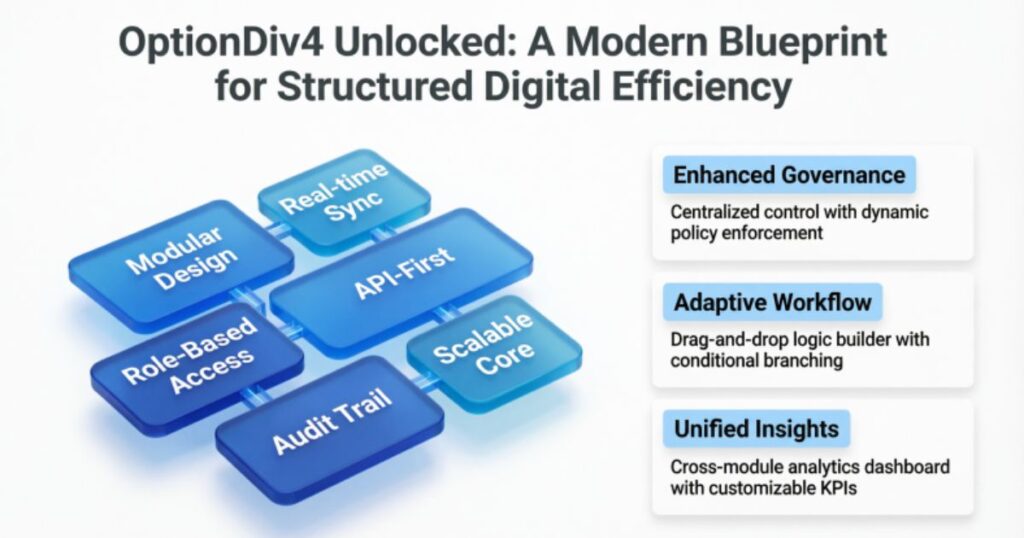
OptionDiv4 Unlocked is not just a catchy title. It represents what happens when you truly understand and apply this framework to your digital projects. The blueprint is simple: organize your decisions into four progressive levels, build intelligent logic that responds to user choices at each level, and design interfaces that reveal complexity gradually rather than overwhelming users from the start.
The results speak for themselves across every industry where OptionDiv4 has been applied. Tech startups reducing coding time by 40 percent. E-commerce stores cutting irrelevant option complaints by 60 percent. Financial platforms improving processing speed by 45 percent. These outcomes are not accidents. They are the natural result of replacing chaotic, unstructured approaches with a clear, proven framework for managing digital complexity.
Start small. Map your existing decision structure and identify where OptionDiv4 principles can bring more clarity and efficiency. Apply the framework to one project or one section of your system first. Measure the results. Then expand. The structured digital efficiency that OptionDiv4 delivers is not a future promise. It is available to you right now with the knowledge this guide has given you. Use it well.

Carter Blake, founder of Top Megazine, is a tech enthusiast and SEO specialist with over 5 years of experience. He creates insightful, well-researched content on technology, trends, and digital innovation for a global audience.