
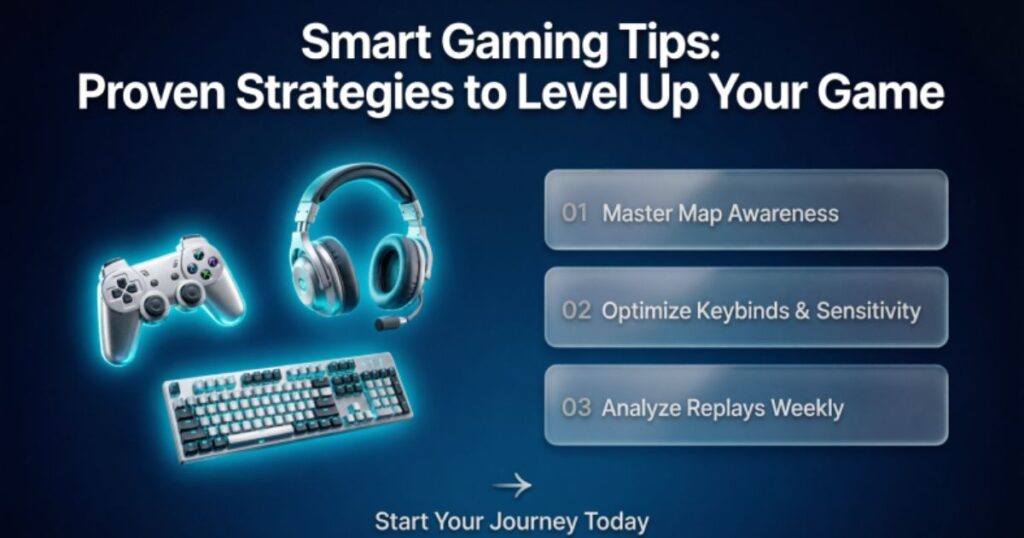
Smart gaming tips are not about expensive gear or raw talent they are about smart habits. Gaming is more than pressing buttons it’s a skill. Whether you play Valorant, PUBG, Fortnite, or mobile titles like MLBB, the right habits separate average players from great ones. Most players grind for hundreds of hours and barely improve, simply because they repeat the same mistakes. This guide breaks that cycle.
These smart gaming tips cover 14 practical strategies covering setup, mindset, mechanics, and teamwork. Each tip is actionable from your very next session. You don’t need expensive gear or natural talent. You just need the right approach and the patience to apply it consistently.
1. Know Your Gaming Style
Before you can improve, you need to understand how you naturally play. Are you aggressive or defensive? Do you think strategically or react instinctively? Self-awareness is the foundation of skill development.
Identify Your Strengths
| Strength | What It Looks Like |
| Fast Reflexes | Quick reactions to sudden threats great for FPS games like CS2 or Valorant |
| Strategic Thinking | Planning rotations and economy ahead of time |
| Team Coordination | Calling shots, grouping up, supporting teammates |
| Adaptability | Switching playstyle based on the match situation |
Fix Your Weaknesses One at a Time
Research in skill acquisition consistently shows that focused, targeted practice on a single weakness outperforms scattered improvement attempts. A 2021 analysis of ranked players across multiple competitive titles found that players who drilled one specific skill per week improved their rank 3x faster on average than those practicing broadly. Pick your biggest problem poor aim, low map awareness, or tilting and work on it for two weeks before moving on.
2. Build the Right Setup
You don’t need expensive gear to win, but a comfortable, stable setup removes unnecessary obstacles. Physical discomfort causes mental fatigue faster than most players realize.
| Setup Element | Why It Matters | Quick Tip |
| Chair & Desk Height | Prevents back and neck pain during long sessions | Elbows at 90 degrees when on keyboard |
| Monitor Height | Reduces eye and neck strain significantly | Top of screen at eye level |
| Room Lighting | Cuts eye fatigue and headaches | Avoid playing in complete darkness |
| Headset | Sound cues reveal enemy positions before you see them | Use stereo or 7.1 surround for best results |
3. Improve Game Awareness
Game awareness is the ability to know what’s happening around you even when you can’t see it. Top-ranked players in games like League of Legends and Apex Legends consistently cite map awareness as their most important skill.
• Study every map: learn common angles, rotation paths, and high-traffic areas
• Listen actively: footsteps, reload sounds, and ability cues tell you where enemies are
• Track the minimap every 5-10 seconds during gameplay
• Focus on objectives, not just kills winning fights doesn’t always win matches
4. Master Controls and Sensitivity
Incorrect sensitivity settings are one of the most common reasons players plateau. Most professionals use lower sensitivity than beginners expect it provides more control at the cost of speed. Find your range, then stick with it.
Rule of thumb: If you’re consistently over-aiming, lower your sensitivity. If you can’t turn fast enough, raise it slightly. Make small changes never jump from 800 DPI to 1600 DPI overnight.
| Setting | Beginner Advice | Why It Matters |
| Mouse DPI | Start at 800 DPI | Consistent baseline for most games |
| In-game Sensitivity | Stay in 0.3-0.6 range (FPS) | Balances speed and precision |
| Keybindings | Remap for comfort, not defaults | Reduces awkward finger stretches |
| Crosshair | Use a small, static crosshair | Easier to place precisely on targets |
5. Smart Gaming Tips: Practice with Purpose
Playing 6 hours of casual matches improves you less than 90 focused minutes with a clear goal. Top esports athletes treat practice like training specific, measurable, and reviewed.
Effective Practice Routine
• Warm up for 10-15 minutes: aim trainers (Aim Lab, KovaaK’s) or in-game aim maps
• Set one goal per session: e.g., ‘I will hold angles instead of peaking today’
• Review 1-2 rounds after each match ask ‘what could I have done differently?’
• Take a break every 90 minutes: your brain retains skills better with rest
• End sessions on a positive note to maintain motivation
6. Understand Game Mechanics
Every competitive game has hidden systems most players ignore. In Valorant, understanding economy wins rounds. In PUBG, knowing bullet drop wins gunfights. In MLBB, knowing skill cooldowns wins team fights.
| Mechanic | Example | Why It Gives an Edge |
| Damage Systems | Headshots deal 2x damage in most FPS games | Aim for head to eliminate faster |
| Cooldowns | Abilities reset after kills in some games | Chain kills strategically for maximum impact |
| Economy/Resources | CSGO buy rounds, MOBA gold management | Correct buys win rounds you shouldn’t |
| Hitboxes | Different characters have different hitbox sizes | Target larger hitboxes under pressure |
7. Communicate Like a Pro
In team-based games like Valorant, Warzone, or MLBB, communication wins more matches than mechanics. One clear callout can save a round. One toxic message can lose the game.
Communication Rules
• Keep callouts short: say ‘B site, two coming’ not a full sentence
• Use positive reinforcement ‘nice shot’ costs nothing and builds morale
• Never blame teammates during a match it breaks focus and destroys team chemistry
• Agree on a strategy before entering a round when possible
• Mute players who are actively hurting team morale, not just losing
Learn more:The Ultimate Guide to the Latest Gaming Trend PblinuxTech
8. Smart Gaming Tips: Control Your Mental Game
‘Tilt’ is the biggest performance killer in gaming. A study of League of Legends ranked players found that players on tilt made 40% more mechanical errors within 10 minutes of a frustrating moment. Emotional control is a skill worth training.
How to Stay Mentally Strong
• Accept losses as data every defeat contains information on what to improve
• Quit after 2 consecutive losses on tilt forcing more games compounds the problem
• Take 5 deep breaths between rounds when frustrated it physically reduces cortisol
• Never play ranked when tired, hungry, or emotionally stressed
• Focus on your own performance, not teammates’ mistakes
9. Build Healthy Gaming Habits
Your body and mind are your most important gaming tools. Sleep deprivation slows reaction time by up to 20%, which no sensitivity setting can compensate for.
| Habit | Impact on Performance | Target |
| Sleep | Boosts reaction time, decision-making, and memory retention | 7-9 hours per night |
| Hydration | Dehydration causes headaches and poor focus | Drink water every 30 minutes while gaming |
| Physical Activity | Improves blood flow and reduces eye fatigue | At least 20 minutes of movement daily |
| Screen Breaks | Prevents eye strain and mental fatigue | 20-20-20 rule: every 20 min, look 20ft away for 20 sec |
| Session Limits | Prevents burnout and maintains motivation long-term | Max 2-3 hour sessions before a real break |
10. Learn from Others Without Copying
Watching pros like TenZ (Valorant), s1mple (CS2), or Faker (League of Legends) is one of the fastest ways to improve if you watch the right way. Copying mechanics blindly rarely works. Understanding decisions does.
Smart Viewing Habits
• Watch VODs, not just highlights highlights show results, VODs show decisions
• Pause and ask: ‘Why did they position there?’ before they make the move
• Focus on one aspect per viewing session: positioning, economy, or communication
• Test what you learn in casual modes before bringing it into ranked
11. Stay Updated Without Information Overload
Games like Fortnite, Valorant, and PUBG push patches regularly. Not every update changes your game. Chasing every meta shift is exhausting and rarely necessary for most skill levels.
• Read patch summaries (usually 2-3 paragraphs) not full technical changelogs
• Focus only on changes affecting your main character, weapon, or role
• Test big changes in unranked matches before adjusting ranked strategy
• Fundamentals aim, game sense, communication outlast every meta shift
12. Avoid the Most Common Mistakes
Most players lose because of repeatable, fixable errors not because of inferior mechanics. Recognizing your patterns is half the battle.
| Mistake | Why It Costs Games | How to Fix It |
| Ignoring Objectives | Kills don’t win games objectives do | Always prioritize the game’s win condition first |
| Over-Aggression | Trading deaths wastes team advantage | Ask: ‘is this push worth it?’ before committing |
| Poor Positioning | Bad position gets you killed before you can react | Watch pro replays to learn standard positions |
| Chasing Kills | Leaves teammates exposed and rotations late | Play for the team, not the killboard |
| Skipping Warm-Up | Cold mechanics lead to early mistakes | Always warm up before ranked sessions |
13. Track Your Long-Term Progress
Real improvement happens slowly and that’s normal. Faker, considered the greatest League of Legends player ever, played over 10,000 ranked games before reaching his peak. Progress is measured in months, not days.
Progress Tracking System
• Set weekly micro-goals: e.g., ‘Improve headshot accuracy by 5%’
• Record stats after each session: KDA, win rate, objectives secured
• Review monthly, not daily daily variance is noise, monthly trends are signal
• Celebrate small wins: every improvement compounds over time
• Expect and embrace plateaus they are normal and temporary
14. Keep Gaming Fun
Performance pressure quietly steals the joy from gaming. The irony is that players who play for fun often improve faster they’re more relaxed, creative, and willing to experiment. Fun is not the opposite of improvement; it’s the fuel for it.
• Try a different game mode when ranked stress builds up
• Play with friends occasionally even casual matches teach teamwork
• Set a ‘fun session’ once a week with no performance goals
• Remember why you started: gaming is entertainment first, competition second
FAQs
How quickly will I see improvement?
Most players notice measurable improvement within 2-4 weeks of applying consistent, focused practice. Aim and game sense improve at different rates aim improves faster, game sense takes months of intentional effort.
Do these tips work for mobile gaming?
Yes. All core principles game awareness, mental control, communication, and deliberate practice apply equally to mobile titles like PUBG Mobile, MLBB, and COD Mobile. Sensitivity and control tips may need adjusting for touchscreen play.
How much should I practice per day?
Quality beats quantity. Two focused hours with clear goals outperforms five hours of mindless grinding. Most serious improvement happens in 90-minute blocks with a short break in between.
What’s the fastest way to improve aim?
Consistency with a fixed sensitivity, daily aim trainer warmups (10-15 minutes), and reviewing your own footage to identify patterns in your misses. Crosshair placement keeping your aim at head level gives faster results than raw aiming speed.
Is expensive gear necessary to get good?
No. A stable setup with a comfortable chair, decent headset, and consistent internet connection is enough. Most pros started with budget gear. Fundamentals matter far more than hardware at most skill levels.
Conclusion
These smart gaming tips prove that getting better at gaming isn’t about talent it’s about habits. The players who improve consistently are those who practice with purpose, manage their mindset, communicate well, and take care of their body. None of these require expensive gear or natural talent.
Apply one smart gaming tip from this guide today. Build it into a habit. Then add another. Small, consistent improvements compound into real skill over time. The best version of your gaming self is built one session at a time.

Carter Blake, founder of Top Megazine, is a tech enthusiast and SEO specialist with over 5 years of experience. He creates insightful, well-researched content on technology, trends, and digital innovation for a global audience.